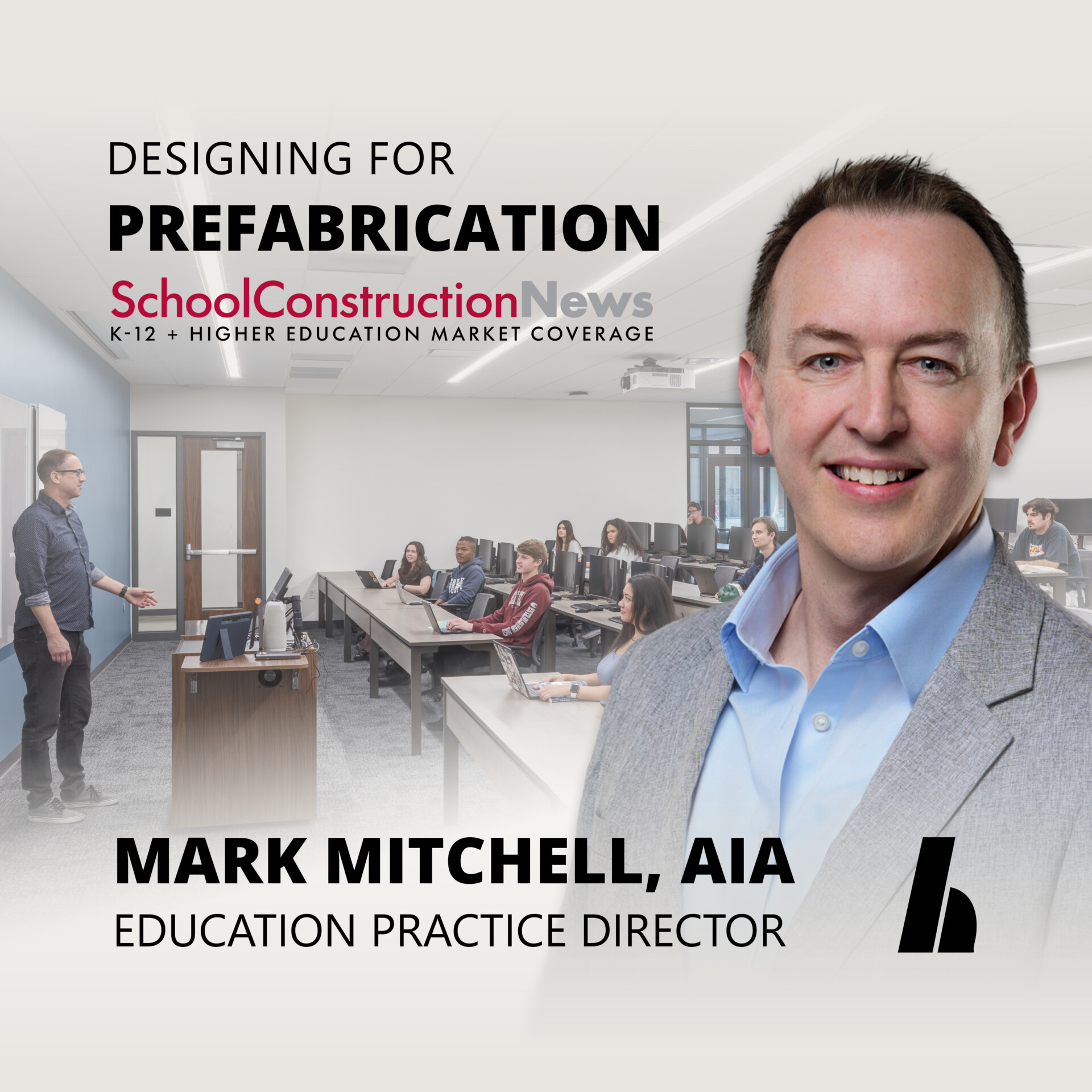
HEAPY Education Practice Director Mark Mitchell explains why successful prefabrication starts well before construction begins
Prefabrication can help project teams improve schedule predictability, quality, safety, and overall project delivery, but realizing those benefits requires more than deciding to fabricate building components off-site. The process needs to begin during design. That is the message from Mark Mitchell, AIA, LEED AP, HEAPY Education Practice Director, in his article, “Prefab Cannot Fix a Project That Was Not Designed for It,” featured in School Construction News.
Drawing on HEAPY’s project experience, Mitchell argues that prefabrication is most effective when architects, engineers, contractors, and owners consider it before the drawings are complete. Waiting until later in the project can limit coordination opportunities and make it harder for teams to capture the efficiencies prefabrication can provide.
The approach represents a shift from viewing prefabrication simply as a construction technique to treating it as an early project-delivery strategy. When teams identify prefabrication opportunities during design, they can coordinate building systems and construction requirements with those opportunities in mind. That early alignment can contribute to more predictable schedules and consistent quality while also supporting safer working conditions.

For education projects, where construction schedules often must accommodate occupied campuses, academic calendars, and narrow windows for on-site work, greater predictability can be particularly valuable.
The lesson is straightforward: teams hoping to capitalize on prefabrication should not wait until construction begins to ask what can be built off-site. They should ask that question while they are designing the project.
Mitchell’s article explores what that approach looks like in practice and why incorporating prefabrication into early project planning can make the difference between simply using prefabricated components and realizing their full potential.
Read “Prefab Cannot Fix a Project That Was Not Designed for It” in School Construction News to learn more about designing projects with prefabrication in mind.